Reduce Manual Safety Patrols On Building Projects: A 2025 Guide For Safety Leaders In Singapore
AI video analytics on existing CCTV cuts manual safety patrols on Singapore building projects, pushing real-time alerts while staying PDPA-aligned.
How AI video analytics on existing CCTV can reduce routine patrols and strengthen safety oversight on building projects.
Construction work in Singapore remains one of the highest-risk activities to manage. The Ministry of Manpower’s Workplace Safety and Health Report shows that construction is consistently among the top sectors for workplace fatalities and major injuries. At the same time, projects are taller, more complex and packed with overlapping trades.
If you are responsible for safety on building projects, you probably feel the limits of manual safety patrols. Supervisors walk long routes, see only snapshots of work and then spend hours writing or consolidating notes. When an incident happens, someone has to scrub through hours of CCTV to reconstruct what went wrong.
This guide explains how you can reduce manual safety patrols on building projects by using AI video analytics on existing CCTV with Invigilo SafeKey, while still strengthening oversight and governance.
Why Do Manual Safety Patrols Struggle On Modern Building Projects?
How do safety patrols typically operate today on construction sites?
On most projects, safety oversight still relies on fixed or semi fixed patrols. Supervisors walk the site at set intervals to check PPE, barricades, access control and work at height platforms. They may capture photos, update checklists and later compile observations into daily or weekly reports.
This model was designed for smaller, simpler job sites. In modern high rise and mixed use developments, it is increasingly difficult for patrols to keep up with the pace and spread of work across multiple towers, podiums and basements.
Where do manual patrols miss important risks on large, multi-level buildings?
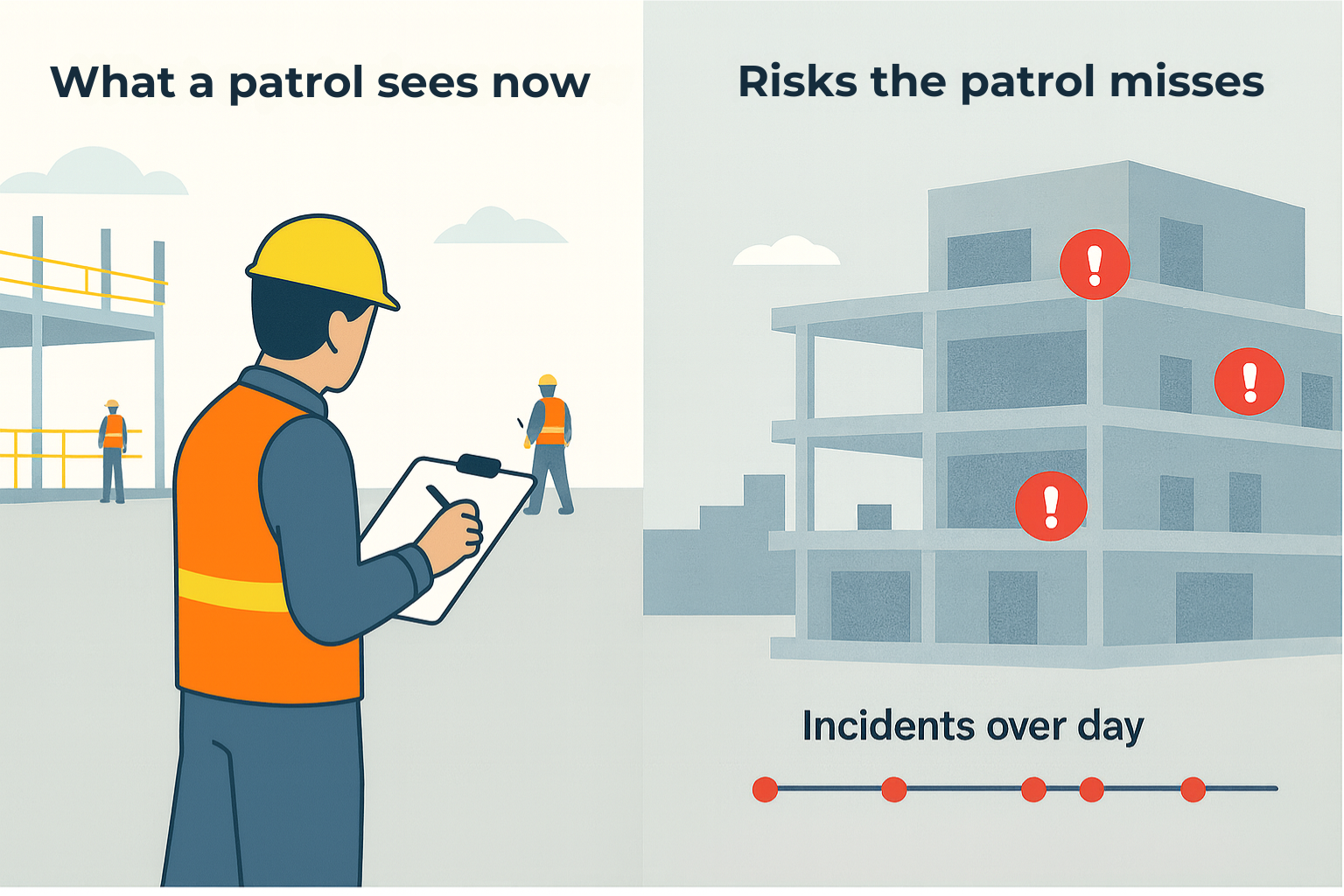
Manual patrols have three obvious limitations:
- They only see a fraction of the workday. Many unsafe acts happen between rounds.
- They cannot cover every level and corner frequently, especially during peak activity.
- They capture incidents as isolated notes or photos, not as patterns and trends.
In Singapore and globally, regulators and clients are paying more attention to proactive controls and evidence. The International Labour Organisation estimates that nearly 3 million people die each year from work-related causes worldwide. In this context, depending mainly on where supervisors can walk and what they happen to see is no longer enough.
How Can AI Video Analytics On Existing CCTV Support Safety On Building Projects?
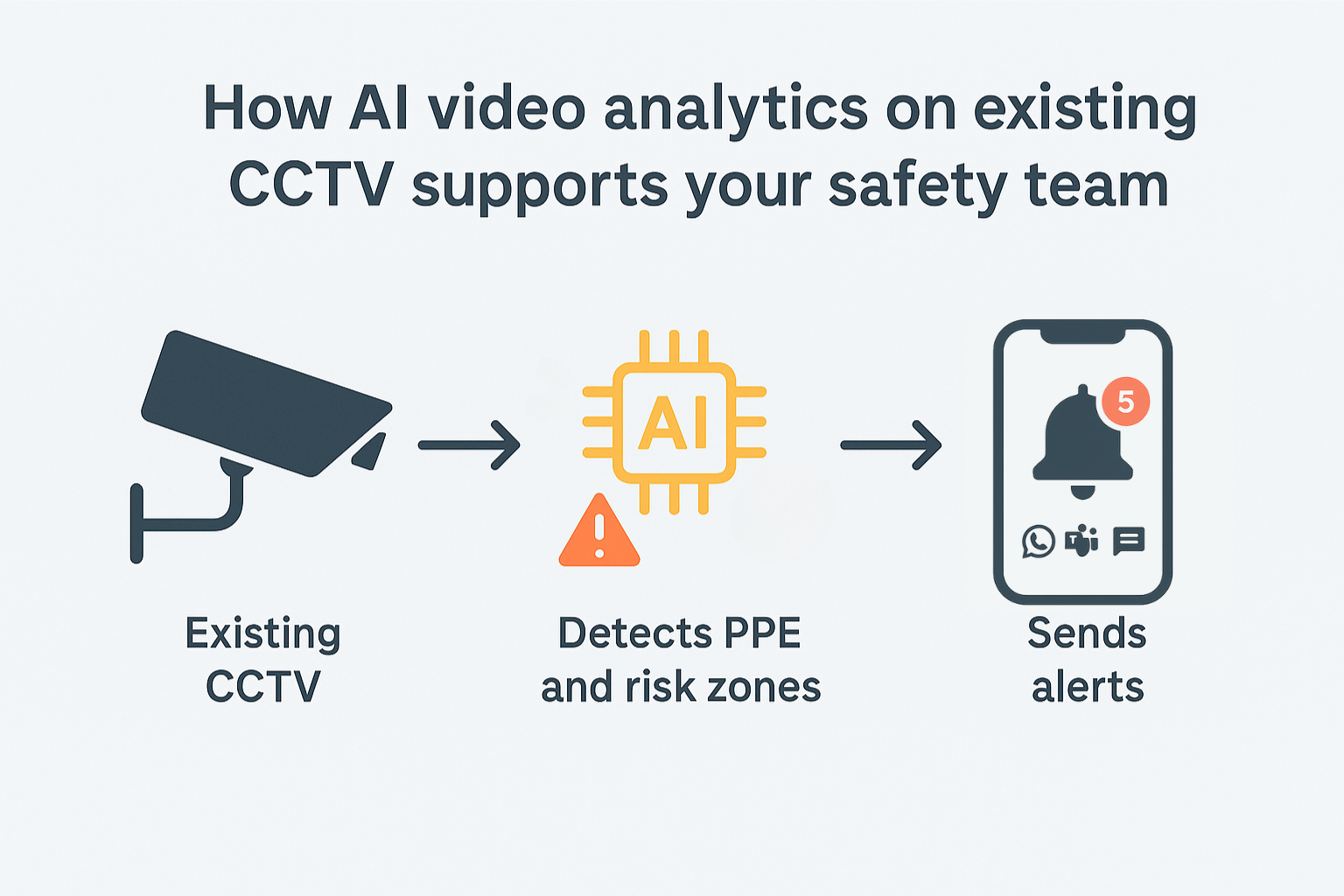
Most building projects already deploy CCTV for security and basic monitoring. Inviglo SafeKey is designed to integrate with existing CCTV and IP camera networks. It connects directly to current cameras and can also work with compatible cameras installed later to cover blind spots.
Once integrated, Invigilo SafeKey runs AI models on the live video feeds. These models are calibrated to detect more than 50 safety risks in real-time, so you get continuous monitoring of high-risk zones without replacing your entire camera stack.
Once integrated, Invigilo SafeKey runs AI models on live video feeds from selected views. You choose the highest risk zones. For example repeated open floors, hoist landings, crane lifting areas and work at height platforms, and SafeKey monitors those zones continuously without replacing your entire camera stack.
From those views, SafeKey detects the conditions supervisors typically walk to check, including:
- PPE non compliance at entrances, hoist landings and scaffold access points.
- People entering crane lifting zones, tower crane slew paths or vehicle exclusion areas.
- Line of fire situations, including persons under suspended loads near crane pads or material hoists.
- Missing or damaged barricades around slab edges, stair cores and floor openings.
- Intrusion into configured red zones such as hoist landing areas and storage decks.
- Work at heights issues, such as missing harnesses or misuse on mobile elevated work platforms and mast climbers.
Detection alone does not change behaviour. Supervisors need to see alerts quickly and in channels they already use. Invigilo SafeKey sends real time notifications to WhatsApp, Microsoft Teams and SMS, while also updating a central dashboard. A supervisor on level 10, for example, can receive an alert that a worker on level 16 is working at the slab edge without a harness, or that a red zone around the crane pad has been entered.
This lets you shift from long, routine patrols to event driven supervision. Patrols still happen, but they are shorter, more targeted and supported by evidence from alerts and video clips.
If you want to get a feel for where AI alerts would help most, book a demo of Invigilo SafeKey and walk through one project’s highest risk zones and camera coverage with the team so you can shortlist two or three hazards to monitor continuously.
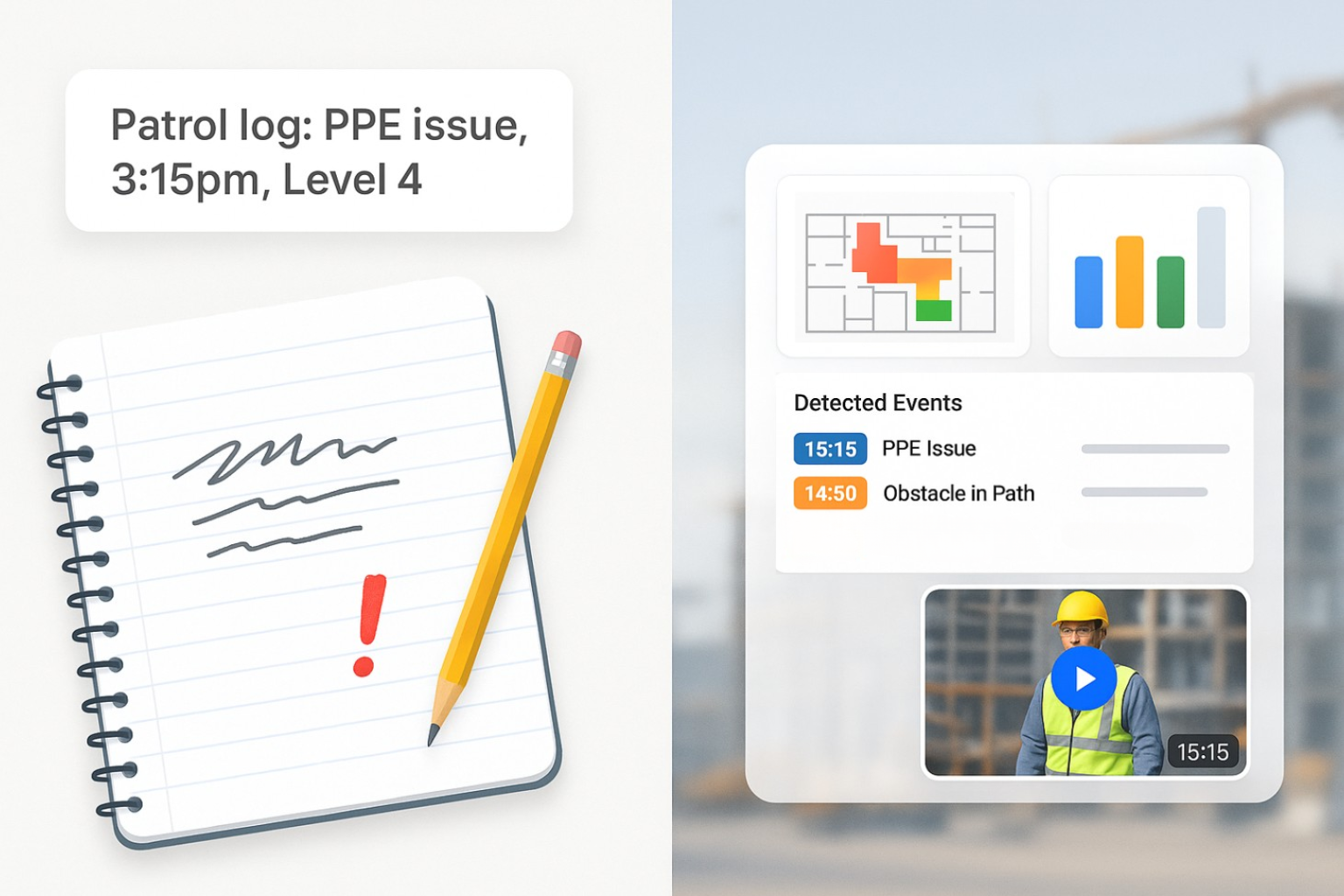
How Do Dashboards And Investigations Help You Move Beyond Handwritten Patrol Logs?
What does the Invigilo SafeKey dashboard show for an active building project?
Once AI monitoring is running, the challenge is no longer “can we see events” but “can we see the bigger picture”.
Invigilo SafeKey provides a dashboard with:
- A centralised stream of detected events by location and time.
- Heatmaps that show where risk clusters across the site.
- Compliance trends over weeks and months.
Instead of reading scattered patrol notes, you can see, for example, that most line-of-fire exposures occur near a particular crane pad late in the afternoon, or that one subcontractor’s crews generate a disproportionate number of PPE alerts.
Invigilo’s analytics content for factories illustrates how these dashboards can support weekly reviews, trend tracking and better planning. The same principles apply when you use Invigilo SafeKey on building projects, with zones and labels tailored to tower cranes, open floors and façade works.
How can AI-assisted video review reduce the time you spend reviewing CCTV after an incident?
When something serious happens, manual CCTV review can consume days. AI-assisted video review changes that process.
Instead of scrubbing through footage camera by camera, you can run large blocks of video through an AI layer that automatically highlights key safety events, flags anomalies and timestamps incidents. You then review a shortlist of relevant clips instead of watching hours of continuous footage.
For patrol reduction, this matters because you no longer depend solely on what was written in notebooks at the time of the incident. You have an objective, video based view of what actually happened on the affected levels and decks. This makes it easier to understand patterns and refine how you deploy supervisors.
If you currently spend a lot of time piecing together incident timelines from raw CCTV, it may be worth booking a demo to see how Invigilo’s AI-powered video review can streamline investigations and free up supervisor time.
How Should You Redesign Your Patrol Plan When AI Is Monitoring Your High Risk Zones?
How do you map routes, cameras and high-risk zones before you change anything?
Before you reduce patrols, you need a clear picture of where you stand. For each project, you can map three things on a simple site plan:
- Current patrol routes and frequencies, for example typical floor walks every two hours or hourly hoist landing checks.
- Camera locations and fields of view, including floors, crane pads, vehicle routes and façade edges.
- High risk zones such as tower crane pads, hoist and lift landings, slab edges, excavations and heavy vehicle routes.
This mapping shows where cameras already cover areas that patrols repeatedly visit, and where gaps still require physical presence. It gives you a basis for deciding where AI can take over some observations and where patrols remain essential.
Which checks can move from manual patrols to AI monitoring in a responsible way?
Based on Invigilo SafeKey’s confirmed detection set, good candidates for AI assisted checks in camera covered areas on building projects include:
- PPE compliance at hoist landings, scaffold access points and site gates.
- Presence and integrity of barricades at slab edges, cores and openings on typical floors.
- Intrusion into configured lifting and crane swing zones.
- Harness use on mobile elevated work platforms and mast climbers.
A cautious approach is to let AI and patrols run in parallel for a defined period. You can then compare what Invigilo SafeKey detects against what patrols see, and gradually adjust patrol frequency where AI coverage is reliable. In zones without cameras, manual patrols remain the primary control.
How Can You Test AI-Assisted Patrol Reduction On One Building Project Before Scaling?
Which zones and metrics should you choose for a first pilot?
A 30 to 60-day pilot on one project gives you evidence without committing to a full rollout.
You can choose two or three zones where:
- Risk is high, for example open edges, busy crane pads or hoist landings
- Cameras already have good views
- Patrols are currently frequent
For these zones, you can track metrics such as:
- Number and type of unsafe events detected by Invigilo SafeKey
- Number of similar events observed during patrols
- Time from detection to corrective action
- Hours spent on CCTV review per incident before and after reviewing the video
The aim is to understand how AI affects both safety visibility and supervisor workload, not to hit a particular percentage. If the pilot shows that AI is catching relevant events and helping supervisors refocus their time, you can start reusing the configuration on similar buildings.
Invigilo SafeKey’s design supports centralised dashboards and multi site monitoring, so you can compare performance across projects, standardise metrics and refine your patrol model over time.
How Do You Stay Compliant And Keep Workers On Your Side While You Reduce Manual Safety Patrols?
How do you align AI-monitoring with PDPA and your internal policies?
Any camera-based monitoring of people must respect privacy laws and company policy. Invigilo’s construction PPE guide highlights PDPA-aligned governance as a core design principle. Invigilo SafeKey supports role-based access, configurable viewing permissions and data retention settings so that deployments can match internal rules.
In practice, you should clearly document:
- The purposes of using AI video analytics.
- Who can see live feeds, alerts and stored clips.
- How long footage and event data are kept.
- How you handle access and deletion requests.
This written governance helps with both PDPA compliance and worker trust, especially when it is shared with contractors and unions.
How do you keep humans in control of safety decisions?
AI does not remove the need for safety professionals. It automates the detection, counting and surfacing of risks. Humans still decide which actions to take, how to communicate and how to shape safety culture.
Supervisors verify alerts and context, safety committees interpret trends and leaders decide how to invest effort. AI gives them better information, but it does not make the decisions.
What Is The Next Step If You Want To Reduce Manual Safety Patrols On Your Building Projects?
Reducing manual safety patrols on building projects is not about walking away from the site. It is about letting AI watch high risk zones continuously through existing CCTV so that supervisors can focus on the parts of safety work that require judgement and conversation.
In this guide, you have seen how:
- Invigilo SafeKey integrates with your current cameras and monitors key building risks in real time
- Alerts on WhatsApp, Teams and SMS allow supervisors to work in an event driven way instead of walking every level on a fixed schedule.
- Dashboards and AI assisted video review provide stronger, evidence based patrol logs than handwritten notes alone.
- Patrol maps, zone selection and short pilots help you adjust patrol frequency in a controlled, measurable way.
If this is a direction you want to explore, a practical next step is to review one active building project, map patrol routes and camera coverage, and identify a small set of zones where Invigilo SafeKey could add the most value.
To discuss how AI video analytics on existing CCTV can help you reduce manual safety patrols on your building projects while maintaining strong safety oversight, you can contact Invigilo through the product page or book a demo of Invigilo SafeKey. This will let you see live detections, dashboards and investigation tools that match the realities of your own sites.
Related posts
Underground Changes Every Safety Rule You Know
Singapore's Cross Island Line runs 70m below ground. Underground construction inverts work at height, plant proximity and lone worker risk. Here is how.

Why Australian Industrial Sites Stopped Buying CCTV AI
Australian HSE leaders aren't buying video analytics anymore. They're buying safety intelligence. Here's what the shift means for WHS in 2026.

What to Demand from AI Video Analytics on an Oil and Gas Site in Saudi Arabia
AI safety platforms built for general workplaces are being sold into Saudi oil and gas operations. Here are the 8 questions that reveal the difference.