Why Australian Industrial Sites Stopped Buying CCTV AI
Australian HSE leaders aren't buying video analytics anymore. They're buying safety intelligence. Here's what the shift means for WHS in 2026.

If you're running HSE at a tier-one Australian site, you've probably sat through at least three "AI video analytics" demos this year.
They all look the same. A vendor opens a laptop, plays a clip of someone walking into a no-go zone, a red box pops up around them, and the vendor says: "See? Now you'll know."
You won't buy it. And it's worth asking why.
It's not because the technology doesn't work. The detection actually does work. The problem is that "video analytics" isn't enough for an Australian safety leader anymore.
You're trying to lower your TRIFR. You're trying to satisfy a board that's reading the industrial manslaughter coverage. You're trying to give your regulator a defensible answer when they ask what controls you have in place. You're trying to make a site that runs 24/7 across two shifts, four contractors, and 60 hectares legible to one HSE manager.
Nobody buys cameras for that. They buy safety intelligence.
This is the shift the industry is in the middle of, and it has real consequences for how Australian operators should be evaluating the next wave of safety technology.
The category problem: video analytics is a feature, not an outcome
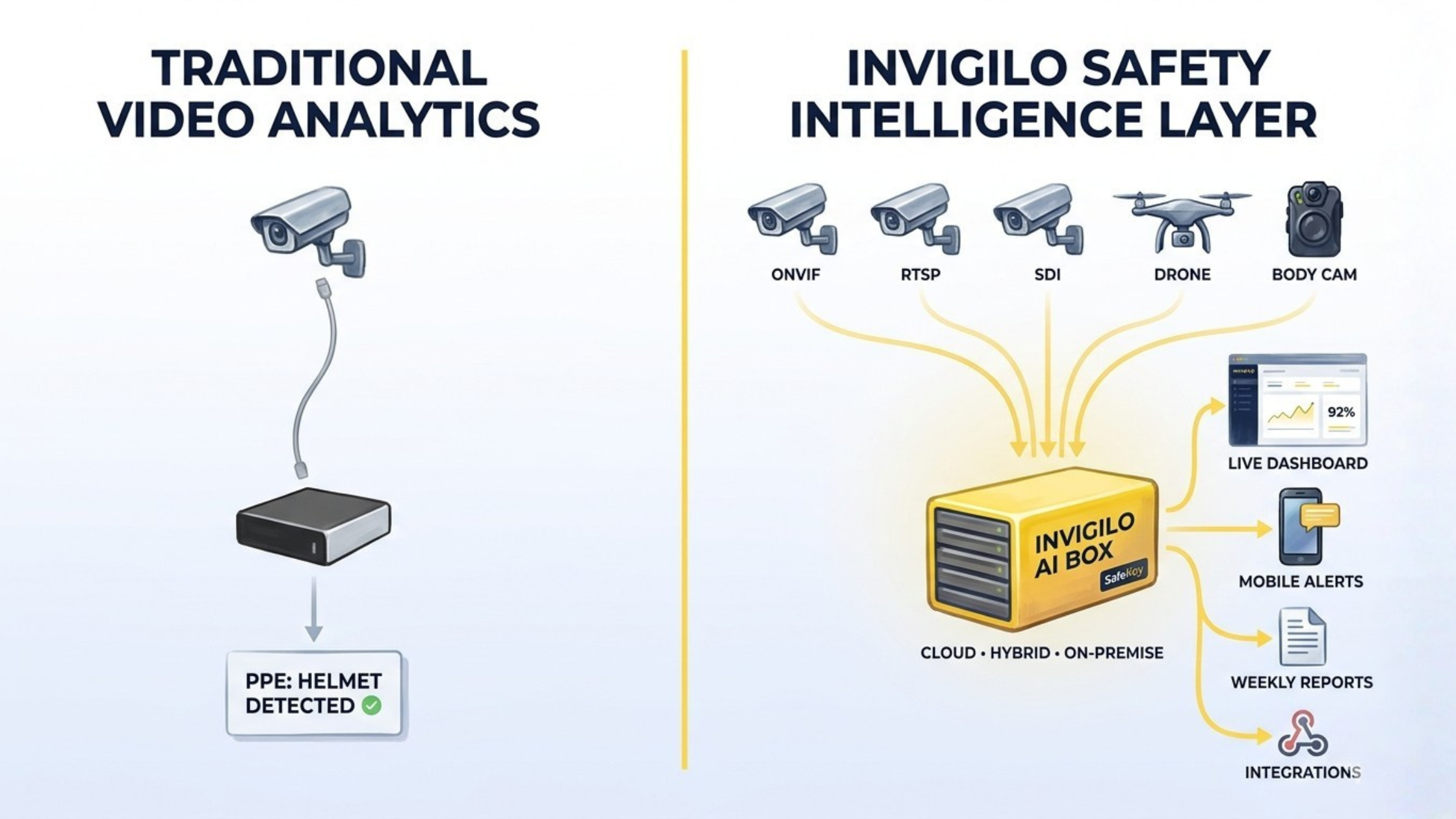
Most vendors in this space still describe themselves with technology words: AI video analytics, computer vision, intelligent CCTV, vision AI. That made sense five years ago when the differentiator was "can the model actually detect a person without PPE." That has changed now.
Detection is solved. What isn't solved is everything that happens after detection:
- How do you know which detections matter and which are noise?
- How do you compare risk between two sites, two contractors, two shifts?
- How do you tell a regulator your risk profile is improving, with evidence rather than anecdote?
- How do you move from one-off interventions to a measurable program?
That layer between raw detections and decisions an HSE leader can actually act on is what we call safety intelligence.
What "safety intelligence" actually means
A safety intelligence layer does four things that a video analytics product, on its own, doesn't:
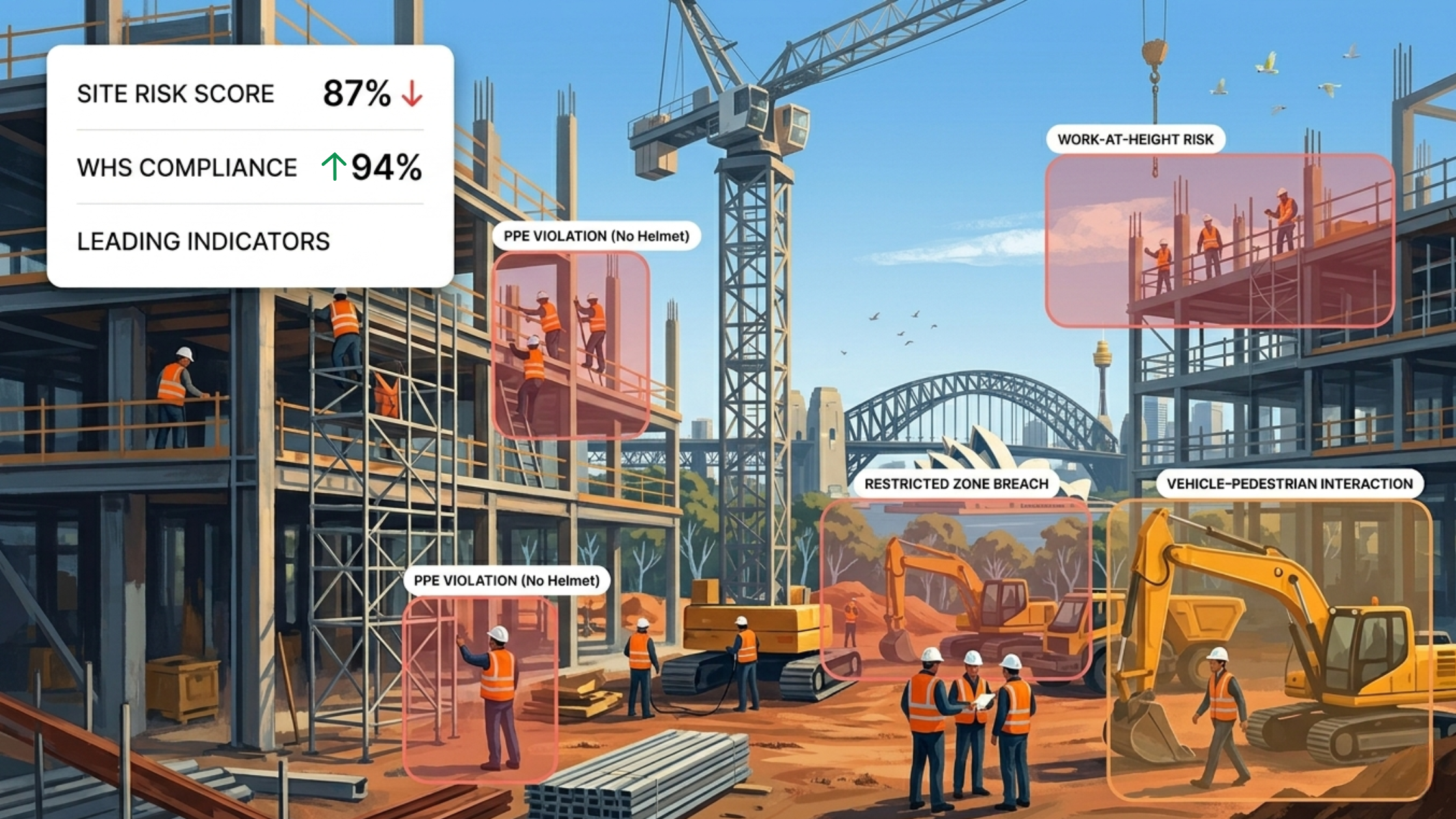
1. It turns events into patterns. A detection of a worker without a hard hat is an event. The fact that 78% of unsafe PPE events happen in the 30 minutes after shift change in Bay 4 is a pattern. Patterns are what change behaviour.
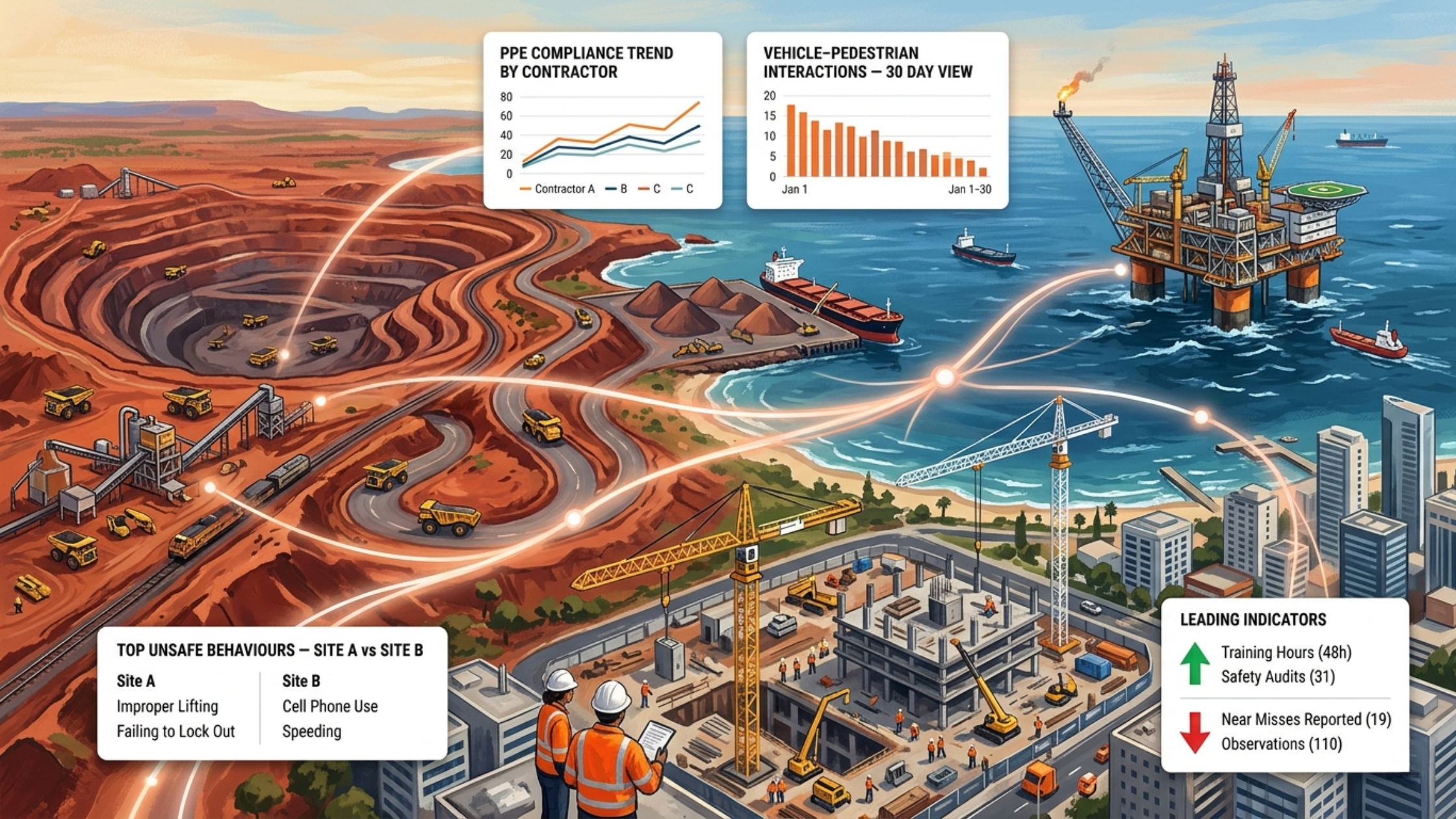
2. It normalises risk across the operation. A single dashboard for one camera is easy. The hard problem is comparing your Karratha site to your Gladstone site fairly, when one runs hot work daily and the other doesn't. Safety intelligence handles the weighting.
3. It produces leading indicators. TRIFR and LTIFR tell you what already happened. A safety intelligence layer surfaces the indicators that predict those numbers: vehicle-pedestrian near interactions, restricted area incursions, PPE compliance trend by contractor, behaviour drift after long shifts.
4. It generates evidence. When the regulator asks what you're doing about a recent notifiable incident, you don't open a PowerPoint. You show a quantified intervention: here's the risk we identified, here's what we changed, here's the trend since.
This is the layer Invigilo is built to be. Not another video analytics tool, but the intelligence layer that sits on top of whatever cameras, sensors, and systems your site already has.
Why this matters specifically in Australia
The Australian WHS environment has shifted in a way that makes the "safety intelligence" category the priority.
A few things are happening at once:
Industrial manslaughter laws are now live in most jurisdictions. Boards and directors are personally exposed to worksites, "we did inspections" is no longer a sufficient defence and regulators expect ongoing, documented risk visibility.
Safe Work Australia has been pushing leading indicators for years. The model WHS framework is explicit that organisations should be using leading indicators to manage risk proactively. Most operators agree in principle. Almost none have the data infrastructure to actually do it.
ISO 45001 expects continuous improvement. Recertification audits increasingly want to see evidence of risk trends, not just registers.
The workforce shape has changed. More contractors, more rotational FIFO crews, more sites running with leaner HSE headcount. A single safety advisor cannot personally observe a 60-hectare site. They need a system that observes for them.
This is the gap. Australian operators have the WHS obligations of a 2026 regulatory environment and the safety data infrastructure of 2015. Safety intelligence closes that gap.
What changes when you treat safety as an intelligence problem
There's a useful test for whether your safety program is operating as intelligence or as inspection. Ask your HSE manager these five questions. If they need to chase down spreadsheets to answer, you're still running an inspection program.
- What were the top three unsafe behaviours on our highest-risk site last week? (Not last quarter. Last week.)
- Which contractor has the highest rate of PPE non-compliance, and is the trend up or down?
- Where on the site do near-miss events cluster?
- Did the intervention we ran in May actually reduce risk in that zone, and by how much?
- If a regulator visited tomorrow, could we hand them a quantified picture of our risk profile?
A safety intelligence layer answers these in seconds. A traditional safety program, even a well-resourced one, takes weeks, and the answer is usually "we'd need to pull that together."
The Invigilo Safety Intelligence Layer
Invigilo is the intelligence layer for industrial safety. It runs on top of your existing infrastructure, including CCTV, IP cameras, access control and site systems, and turns that infrastructure into a continuous source of risk visibility.
It does three things end to end:
- Sees: converts video and operational signals into structured safety events
- Understands: clusters those events into patterns, ranks them by risk, and benchmarks them across sites and contractors
- Acts: surfaces leading indicators to HSE leaders, automates alerts to the right people, and produces the evidence trail a regulator or auditor expects
It's deployed today across construction sites, oil and gas facilities, and manufacturing plants in Singapore, the Middle East, and Asia-Pacific. The question we're getting most from Australian operators isn't whether the technology works. It's the practical deployment questions below.
5 questions Australian HSE leaders ask before deploying Invigilo
These are the actual questions we get from safety managers, HSE directors, and procurement teams evaluating Invigilo for Australian sites. Worth covering them directly.
1. Do we need to install new cameras, or can Invigilo run on our existing CCTV?
In most cases, your existing CCTV is fine. Invigilo is camera-agnostic and works with standard IP cameras, including the infrastructure you've already paid for. We do an upfront site survey to confirm camera placement and field of view are usable for the safety scenarios you want to cover (PPE, vehicle-pedestrian, restricted zones, ergonomic risk, etc.). If specific zones have blind spots, we'll flag them, but the default expectation is that you're not replacing hardware.
For greenfield Australian sites, particularly remote ones with limited connectivity, we'll often design a hybrid edge + cloud setup so the intelligence layer runs without needing constant bandwidth back to a head office.
2. How long does deployment take, and what does the rollout actually look like?
A single-site deployment typically goes live in 4 to 8 weeks. The phases are:
- Weeks 1 to 2: Site survey, camera audit, safety scenario scoping with your HSE team
- Weeks 3 to 4: Integration with your existing CCTV/VMS, model tuning to your site environment (lighting, PPE specs, vehicle types)
- Weeks 5 to 6: Pilot zone live, baseline data collection, alert routing configured
- Weeks 7 to 8: Full site go-live, dashboards calibrated, handover to HSE team
For multi-site programs, common for Australian mining and energy operators, we recommend starting with one site, validating the leading indicators against your existing safety data for 60 days, then rolling out the playbook to subsequent sites.
3. How does Invigilo handle worker privacy and union concerns?
This is the question that comes up first in any Australian deployment, and rightly so.
No facial recognition by default. Invigilo identifies safety behaviours and PPE compliance, not individuals. The system can detect that a worker is missing a hard hat. It does not identify which worker.
Data stays where you decide. For Australian deployments we offer regional data residency, including on-premise options for sites with strict data sovereignty requirements (common in defence-adjacent manufacturing and critical infrastructure).
4. How does Invigilo integrate with our existing safety management platform such as Cority, Donesafe, Enablon or in-house systems?
Invigilo is designed to sit alongside your SMS, not replace it. We integrate via API into the major platforms, including Cority, Enablon, Donesafe and Intelex, plus most in-house safety systems, so events and trends flow into your existing reporting structure.
Practically, this means your incident register, observation reports, and HSE dashboards stay where they are. Invigilo adds the leading-indicator and risk-pattern layer on top. For organisations running ISO 45001, the integration is configured to produce the documented evidence your audit cycle expects.
5. What's the difference between Invigilo and the analytics module my CCTV vendor already offers?
Reasonable question, because most VMS vendors now bundle some level of "AI analytics."
The difference is the layer they operate at. A VMS analytics module is built to make a single camera smarter: count people, detect motion, draw a box around a person without PPE. It's a feature inside the camera system.
Invigilo is built to make a safety program smarter. It aggregates events across cameras, sites, contractors, and time; weights them by risk; benchmarks them; produces leading indicators; and outputs intelligence an HSE leader can act on.
A useful analogy: your VMS analytics is like a smoke detector. Invigilo is like an actual fire safety program. You need both, but they're different categories of tool. Most operators start with one and outgrow it within 12 months.
What to do next
If you're an Australian HSE leader thinking about how to move your program from inspection-based to intelligence-based, the practical first step is a baseline. If you're in this space and want to see what the intelligence layer looks like running on a site comparable to yours, contact us and we'll show you a live dashboard from a deployment in a similar industry.
The shift from video analytics to safety intelligence is happening whether vendors describe it that way or not. The operators getting ahead of it are the ones who'll have the data when their regulator, board, or auditor next asks the hard questions.
Invigilo is the safety intelligence layer for industrial operations. We help construction, oil & gas, and manufacturing operators turn existing CCTV and site infrastructure into continuous safety visibility, surfacing leading indicators, benchmarking risk, and producing the evidence trail modern WHS environments demand.
Related posts
Underground Changes Every Safety Rule You Know
Singapore's Cross Island Line runs 70m below ground. Underground construction inverts work at height, plant proximity and lone worker risk. Here is how.

What to Demand from AI Video Analytics on an Oil and Gas Site in Saudi Arabia
AI safety platforms built for general workplaces are being sold into Saudi oil and gas operations. Here are the 8 questions that reveal the difference.
Construction Safety AI for Saudi Arabia
Construction safety AI helps Saudi HSE teams detect PPE violations, missing barricades, restricted zone entry and work-at-height risks in real time.