How to Prevent Line of Fire Incidents in Manufacturing With AI Cameras
AI video analytics detects when someone enters the exclusion zone under a suspended load during active lifting and alerts supervisors in real time.
How to Prevent Line of Fire Incidents in Manufacturing With AI Cameras
How To Stop People From Walking Under Suspended Loads
If you are looking up preventing line of fire incidents in manufacturing with ai, you are likely trying to solve a very specific problem: people drifting into the danger zone during lifting, especially when a load is suspended and moving across a bay.
This article focuses on one high-impact risk that factories can control quickly: keeping unauthorised people out of suspended-load areas. You will get a simple way to define the danger zone, reduce alert noise, and build a repeatable response that supervisors will actually use.
Before you plan anything, it can help to look through Invigilo’s solutions and use cases so you can match the right workflows to your plant’s lifting areas.
What Is A Line Of Fire Incident In A Factory?
A line of fire incident happens when a person is in the path of something that can strike, crush, or trap them. In manufacturing, that “something” often involves moving loads, moving equipment, or sudden movement during routine work.
This guide focuses on the most direct and common version: people under, inside, or too close to a suspended load while it is being lifted or moved.
What does “line of fire” mean during overhead lifting?
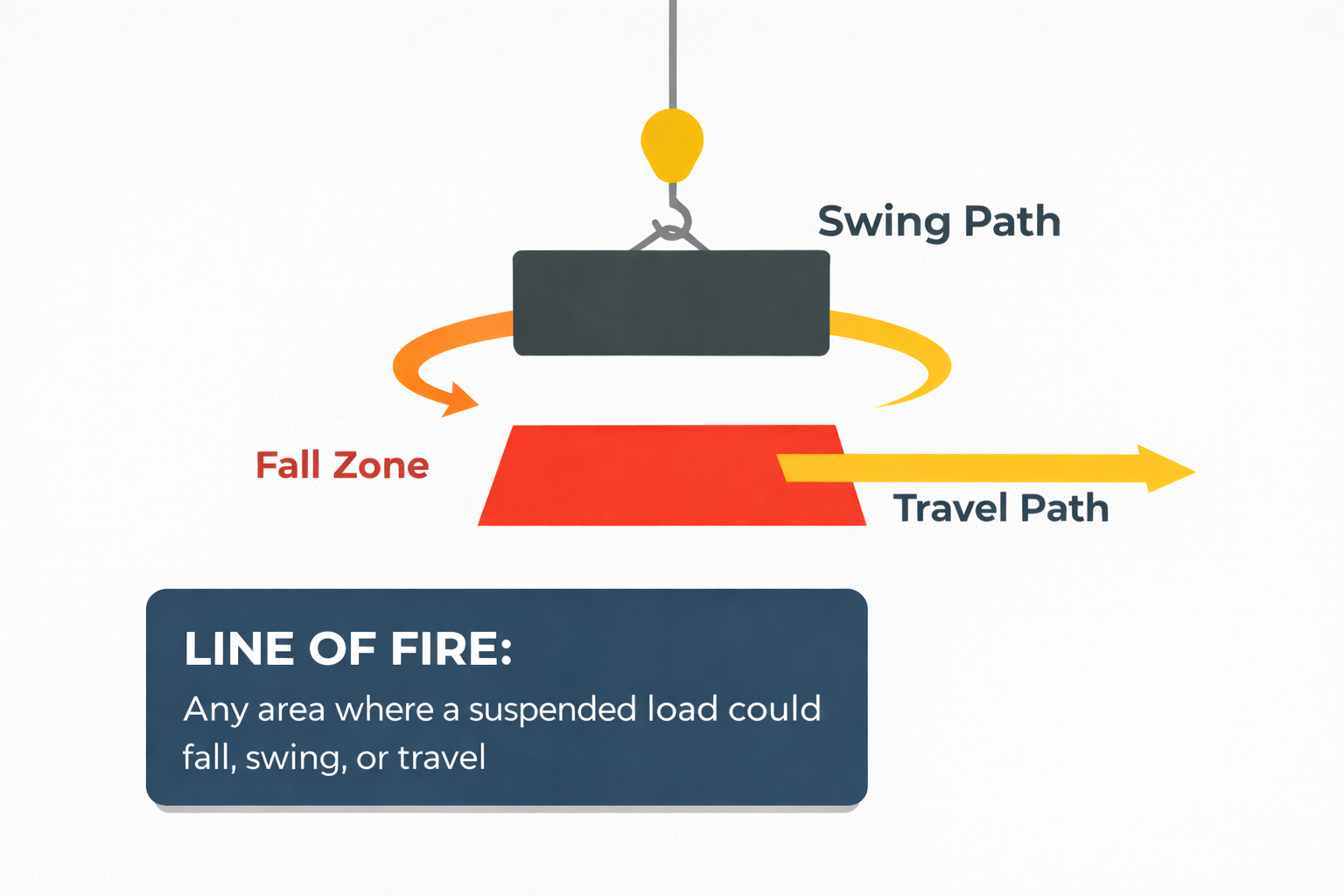
During lifting, the line of fire is not only “under the hook”. It usually includes:
- The area where the load could fall
- The area where the load could swing or rotate
- The path the load travels from pickup to placement
If someone is in these areas during a lift and they are not part of the authorised lifting team, you have a preventable exposure.
Why do line of fire incidents still happen when lifting rules exist?
Most factories already have lifting rules. The gap is not knowledge. The gap is real-time control.
Line of fire exposure still happens because:
- Boundaries are unclear or not enforced in the moment
- People take the shortest route through a bay
- Lifts happen during changeovers when the floor is busy
- The lifting crew is focused on the load and cannot watch every edge
This is where AI safety cameras can help. Not to replace lift planning, but to make the drift into danger visible the moment it starts. If you are considering camera-based line of fire detection, you can check Invigilo’s suspended-load workflow and see whether it fits your lifting areas.
Where Do Suspended Load Lines Of Fire Risks Happen Most In Manufacturing?
The highest-risk situations are usually the ones that happen often. Repetition is what makes prevention measurable.
Which lifting tasks create the highest risk of people walking under loads?
Risk clusters around routine moves like:
- Changeovers and tool moves (dies, moulds, jigs, fixtures)
- Moving materials between bays using overhead cranes or hoists
- Repositioning loads during “quick adjustments”
- Maintenance lifts where multiple teams are nearby
These tasks feel normal, so people become less careful. That is why they are a good place to start.
What blind spots make lifting bays risky?
Blind spots are not only about camera angles. They are often created by how people move:
- Crossing points where the shortest route cuts through the lifting area
- Places where people wait for parts and naturally gather
- Corners, columns, or racks that hide the edge of a bay
- Shared zones where lifting and production overlap
A simple rule helps: if people repeatedly end up in the same place during lifts, your layout and routine are inviting it. Controls should remove the invitation, not just remind people to “be careful”.
How Can AI Safety Cameras Prevent People From Walking Under Suspended Loads?
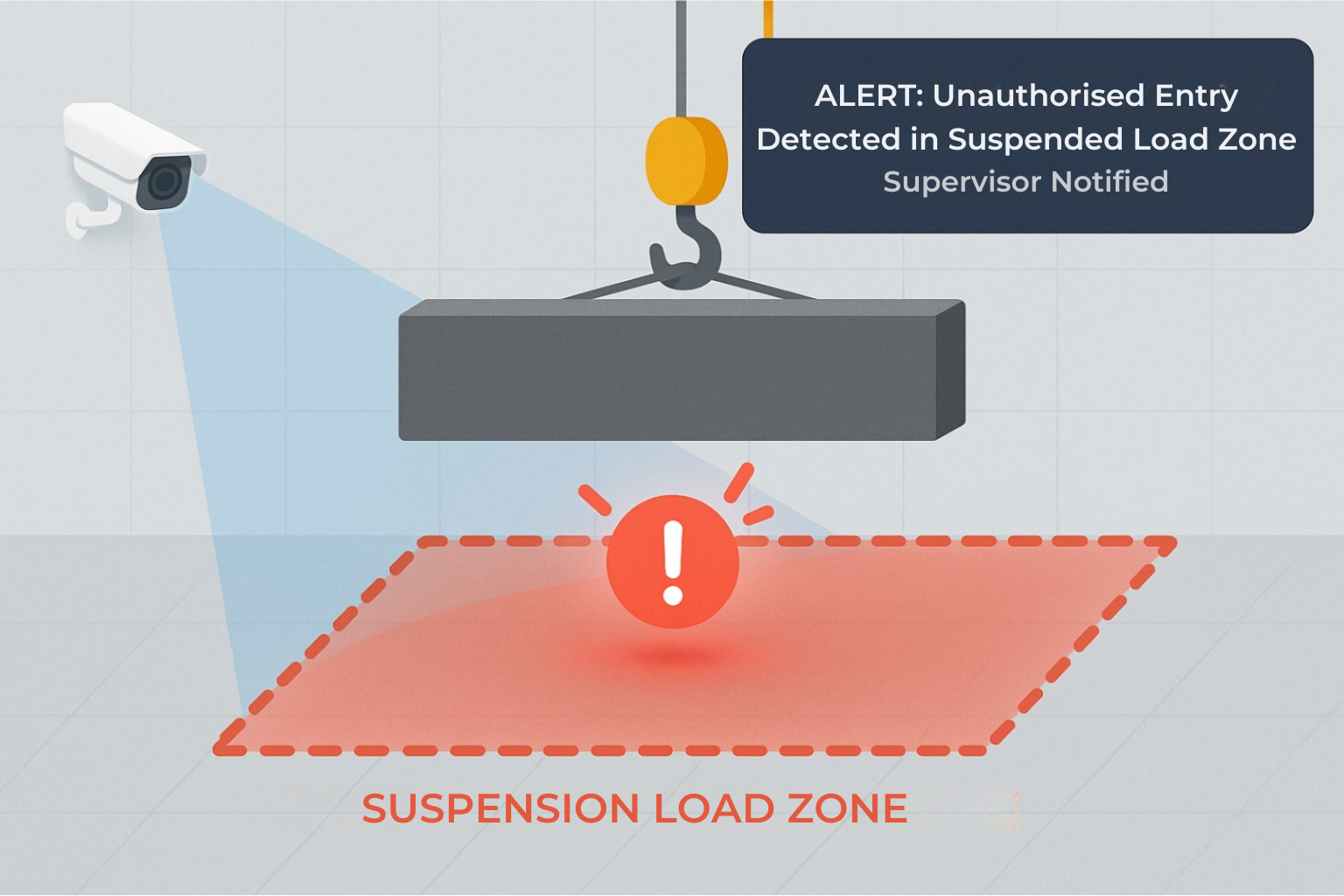
AI video analytics can monitor a lifting area and alert when someone is inside the defined danger zone while a lift is active. The goal is to stop the unsafe moment before it becomes an incident.
What should an AI system detect for “person under suspended load” prevention?
To be useful on a factory floor, detection should be clear and easy to explain:
- A lift is happening and a load is suspended
- A person enters the defined exclusion zone
- The person is not meant to be there, based on your site rules
You are not trying to build a complex system. You are trying to enforce one high-risk boundary consistently.
How do you avoid alerting on authorised riggers and the lifting crew?
This is where many programmes fail. If alerts trigger on the people doing the lift properly, supervisors lose trust fast.
A practical setup separates:
- Authorised lifting personnel, who may need to be close to the load to guide positioning
- Bystanders and passers-by, who should not be inside the zone during lifting
When you evaluate Invigilo, this is one of the most important questions to ask: how the workflow is set up to keep alerts meaningful so teams do not tune them out.
If you are unsure whether your lifting bay cameras are suitable, you can share a couple of typical views with Invigilo and ask what is realistic for your layout. That quick check can save weeks of guesswork.
When should the system send alerts so you avoid noise?
If alerts run all day in a busy bay, people will stop paying attention.
Keep it simple. Define when the rule matters most, for example:
- During planned lift windows
- During changeovers and heavy moves
- When a bay is placed into a “lifting mode” as part of the work plan
Clear “lift active” windows reduce noise and make the rule feel fair.

How Do You Set Up A Lifting Exclusion Zone For Suspended Loads That People Actually Follow?
AI helps, but the foundation is still a visible, reasonable rule that fits how people work.
What is the simplest exclusion rule to enforce on day one?
Use a rule that anyone can understand in one sentence:
When a load is suspended, only the authorised lifting crew is allowed inside the marked exclusion zone. Everyone else stays out.
Make the zone tight and realistic. If the zone blocks normal movement all the time, people will ignore it. If it matches the real hazard boundary, compliance improves because it feels reasonable.
Who should respond to an alert and what should they do?
Alerts only help if the response is clear.
A simple response loop:
- Acknowledge the alert
- Clear the zone if lifting is ongoing
- Note a short reason in plain words (shortcut route, walkway blocked, unclear boundary)
- Fix the cause if it repeats
This keeps the programme focused on prevention, not blame.
What should you change when the same hotspot keeps triggering alerts?
Repeated alerts are useful. They tell you where the system is failing, not where people are “bad”.
Common fixes include:
- Adjust pedestrian routes so the shortest path does not cut through the bay
- Improve floor markings or barriers so the boundary is obvious at a glance
- Change the travel path so the load does not cross busy areas
- Make lift-active periods part of daily planning so teams know when rules tighten
If lifting is only one part of your risk picture, you might also find Invigilo’s manufacturing guides helpful, especially their posts on PPE compliance monitoring, unsafe proximity to machinery, and forklift safety. For this article, we stay focused on suspended loads.
How Does Invigilo Safekey Support Line Of Fire Detection For Manufacturing Lifting Areas?
Think of this section as a checklist of what to look for, using Invigilo as a reference.
What can you evaluate in Invigilo’s line of fire workflow?
For this use case, you want to evaluate whether the workflow supports:
- Detecting people under a suspended load in real time
- Reducing noise by keeping alerts relevant to the situation on the floor
- Logging events so teams can review what happened and what changed
If you want to see what else Invigilo can support in manufacturing beyond lifting bays, take a quick look at their solutions overview and shortlist the workflows that match your plant.
How should you scope a quick walkthrough or pilot with Invigilo?
The fastest way to get a useful answer is to share:
- The lifting hotspots (which bays, which moves, which times)
- What “authorised lifting crew” means on your site
- One or two typical camera views
- The response owner for alerts (supervisor, lifting lead, EHS)
You are not trying to test everything. You are trying to prove one high-risk rule can be enforced consistently without creating noise.
What Should Your Next Steps Be To Reduce Line Of Fire Risk From Suspended Loads?
If you want fewer line of fire moments during lifting, start small and stay consistent:
- Pick one lifting bay where lifts happen often
- Define a clear exclusion zone that matches the real danger boundary
- Enforce one simple rule that is easy to coach
- Review repeats and remove the reasons people drift into the zone
If you want to set this up properly and avoid guesswork, contact Invigilo and ask for a line of fire detection walkthrough for your lifting bays. Share your lifting hotspots, a couple of camera views, and how your lifts typically run. Their team can recommend the most suitable workflow for your site and help you scope what is realistic to implement first.
Related posts
Underground Changes Every Safety Rule You Know
Singapore's Cross Island Line runs 70m below ground. Underground construction inverts work at height, plant proximity and lone worker risk. Here is how.

Why Australian Industrial Sites Stopped Buying CCTV AI
Australian HSE leaders aren't buying video analytics anymore. They're buying safety intelligence. Here's what the shift means for WHS in 2026.

What to Demand from AI Video Analytics on an Oil and Gas Site in Saudi Arabia
AI safety platforms built for general workplaces are being sold into Saudi oil and gas operations. Here are the 8 questions that reveal the difference.