AI Solution For Monitoring PPE Compliance In Manufacturing Plants
Choosing PPE monitoring AI is about whether it works on your actual camera views and SOPs. Learn the workflow, pilot plan, and vendor criteria.
Manufacturing leaders are moving from posters and periodic audits to systems that make safety observable in real time. An AI solution for monitoring PPE compliance in manufacturing plants gives supervisors live visibility of helmet, high-visibility vest, glove and goggle use, and it helps teams intervene quickly when rules are missed. Done well, the approach connects to existing camera networks, posts actionable alerts to shop-floor communication channels, and builds a defensible record of what happened, when it happened, and how it was resolved. This article explains the 2024 - 2025 context, why it matters for finance and operations, how to run a pilot that proves value without slowing production, how to choose a vendor, and what to expect as the field evolves.
What Changed In 2024 - 2025 That Makes PPE Monitoring With Computer Vision More Urgent?
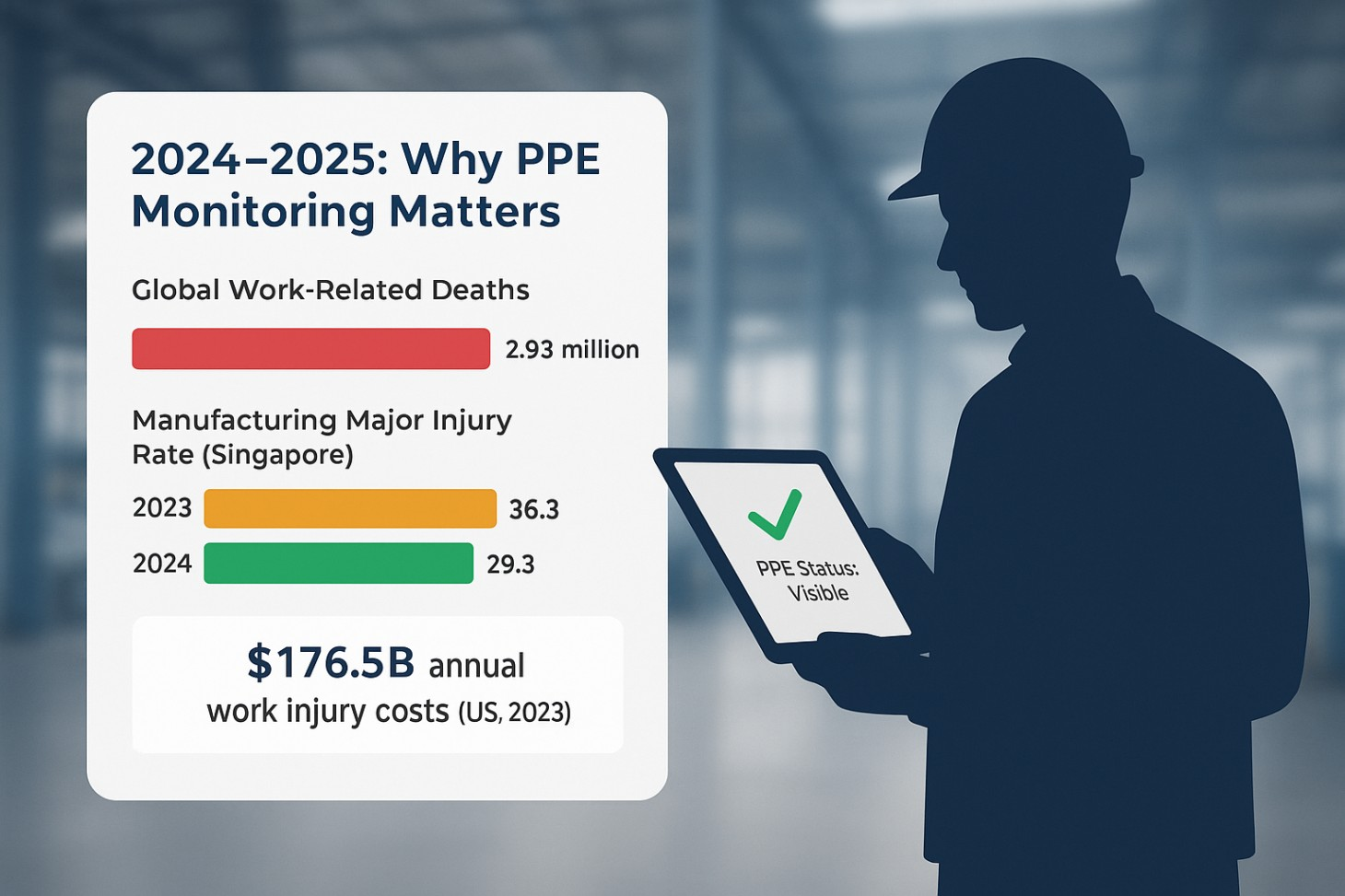
Two signals shaped buyer urgency in 2024 - 2025. First, the global burden of occupational harm remains high. Current international estimates indicate 2.93 million work-related deaths and hundreds of millions of non-fatal injuries annually, which keep prevention and early intervention on the executive agenda for industrial firms.
Second, national regulators continue to publish sector-level performance that focuses attention on manufacturing risk. In Singapore, the official Workplace Safety and Health Report 2024 shows manufacturing improved its combined fatal and major injury rate from 36.3 per 100,000 workers in 2023 to 29.3 in 2024, which is progress but still demands vigilance in plants with complex machinery and shift operations. The January to June 2025 update reported no manufacturing workplace fatalities in that half-year period, reinforcing the value of consistent controls and faster interventions.
Costs remain significant when incidents occur. The US National Safety Council estimates $176.5 billion in total work injury costs in 2023, with $43,000 per medically consulted injury, figures that concentrate minds in finance and operations when evaluating prevention technology. Enforcement data adds another prompt. OSHA’s annually reported most frequently cited standards continue to include personal protective equipment requirements, a reminder that eye and face protection lapses and related PPE issues keep showing up in inspections across industries.
The planning implication is clear. Manufacturers need PPE compliance that is visible between audits, measurable between toolbox talks, and integrated enough that supervisors can act in minutes, not after the shift ends. Computer vision is not a silver bullet, yet it is a practical way to close the observation gap if deployed with care.
Why Does Factory PPE Monitoring With AI Matter Now, And What Are The Financial, Legal And Operational Implications?
This matters because preventable harm often happens in the space between formal inspections. When supervisors cannot see whether rules are followed at the point of risk, they only discover misses after an incident, a near miss, or an audit.
Financially, each avoidable injury compounds costs in lost time, line stoppages, quality issues and insurance exposure, which cascade beyond the individual case.
Legally and reputationally, regulators expect employers to ensure reasonably practicable controls and to demonstrate that those controls work in practice. Real-time visibility helps show that PPE policies are active controls rather than shelf documents. Operationally, the advantage is speed. When a helmet or goggle miss is flagged as a person enters a zone, supervisors can intervene before the task begins. That keeps lines running and reduces the need for rework or lengthy investigations.
In this context, interest has shifted to factory-ready computer-vision tools that integrate with existing site cameras, push real-time notifications via WhatsApp, Microsoft Teams or SMS, and record events in a central dashboard that supports review and learning. These capabilities are publicly described for Invigilo SafeKey and are representative of how mature systems present themselves to buyers. If you are close to a buying decision, evaluate how these capabilities work on your floor and with your rules, not in a lab or marketing video.
If you want to see how this looks on your floor, book a demo with Invigilo and ask to validate detections and alert routes on your actual camera feeds.
What Does A Modern Factory-Ready PPE Monitoring Workflow Look Like Today?
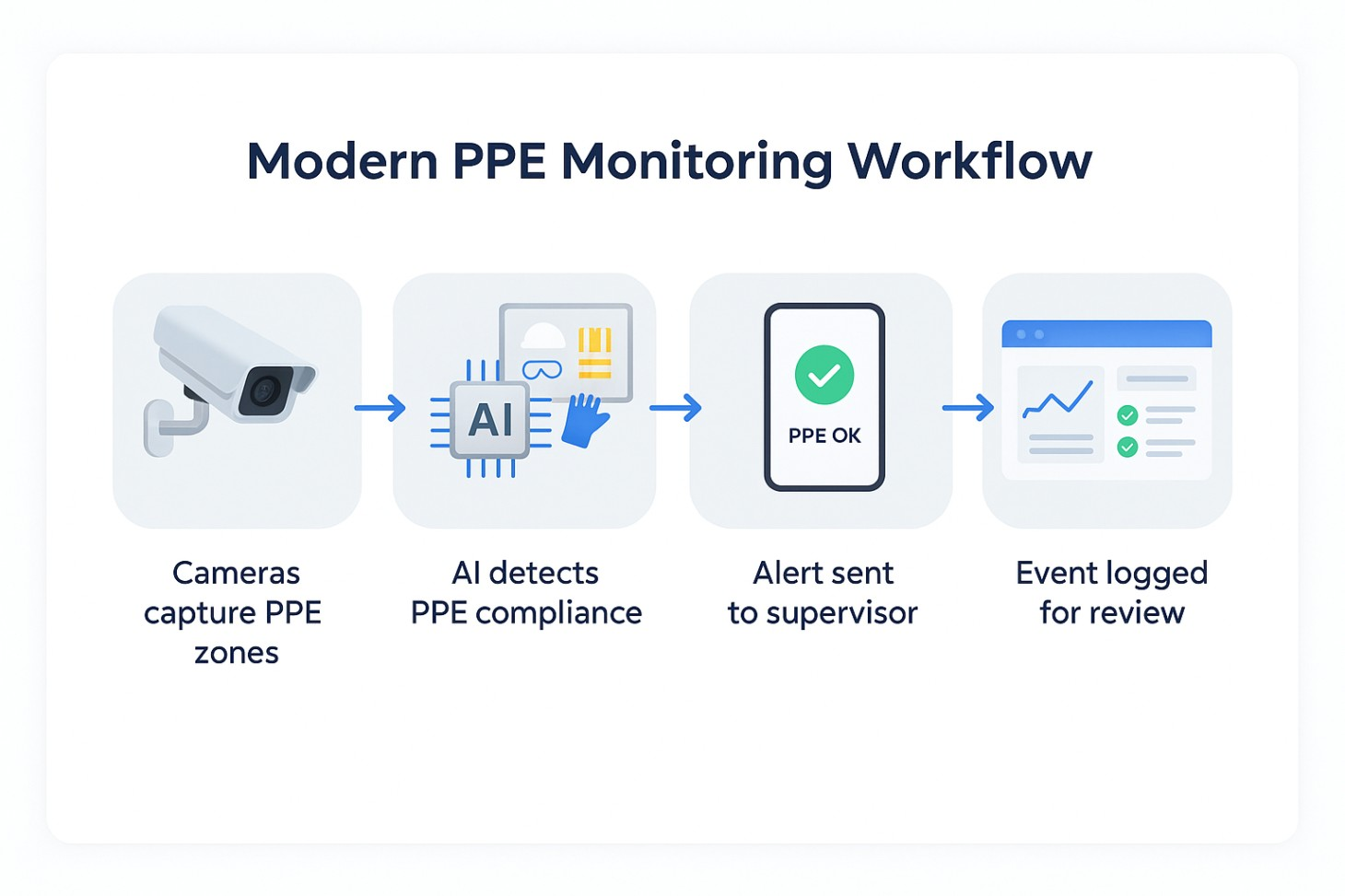
A practical workflow looks like this. Cameras capture views at the point where rules apply. A video analytics service processes those views to detect PPE non-compliance and other unsafe actions relevant to manufacturing, including proximity to operating machinery and SOP breaches where supported. Invigilo’s manufacturing page describes this category of detections for factory use. When the system detects a likely non-compliance, it pushes an alert with evidence to channels your teams already use, for example, WhatsApp, Microsoft Teams or SMS, and logs the event for later review. The priority is to make alert content immediately useful, so a supervisor can nudge, coach or stop work without delay and without guessing which camera or zone triggered the issue.
Two practical notes keep the workflow grounded. First, the detection scope varies by vendor and by how you configure the system. Invigilo’s site states coverage of over 50 safety risks and references 85%+ verified detection accuracy. but the exact list and measured performance should be validated during your evaluation on your camera views and SOPs.
Second, some deployments require additional privacy and governance measures. Retention periods, masking and role-based access should be aligned with your internal policy and local regulations before go-live. For PDPA in Singapore and GDPR in the EU, refer to the official guidance used by compliance teams when deploying video analytics.
To check how would the detection scope maps to your plant, hop onto a short demo with Invigilo and request a short note summarising what was validated in the session.
How Should We Run A 30-Day Pilot That Validates Value Without Slowing Production?
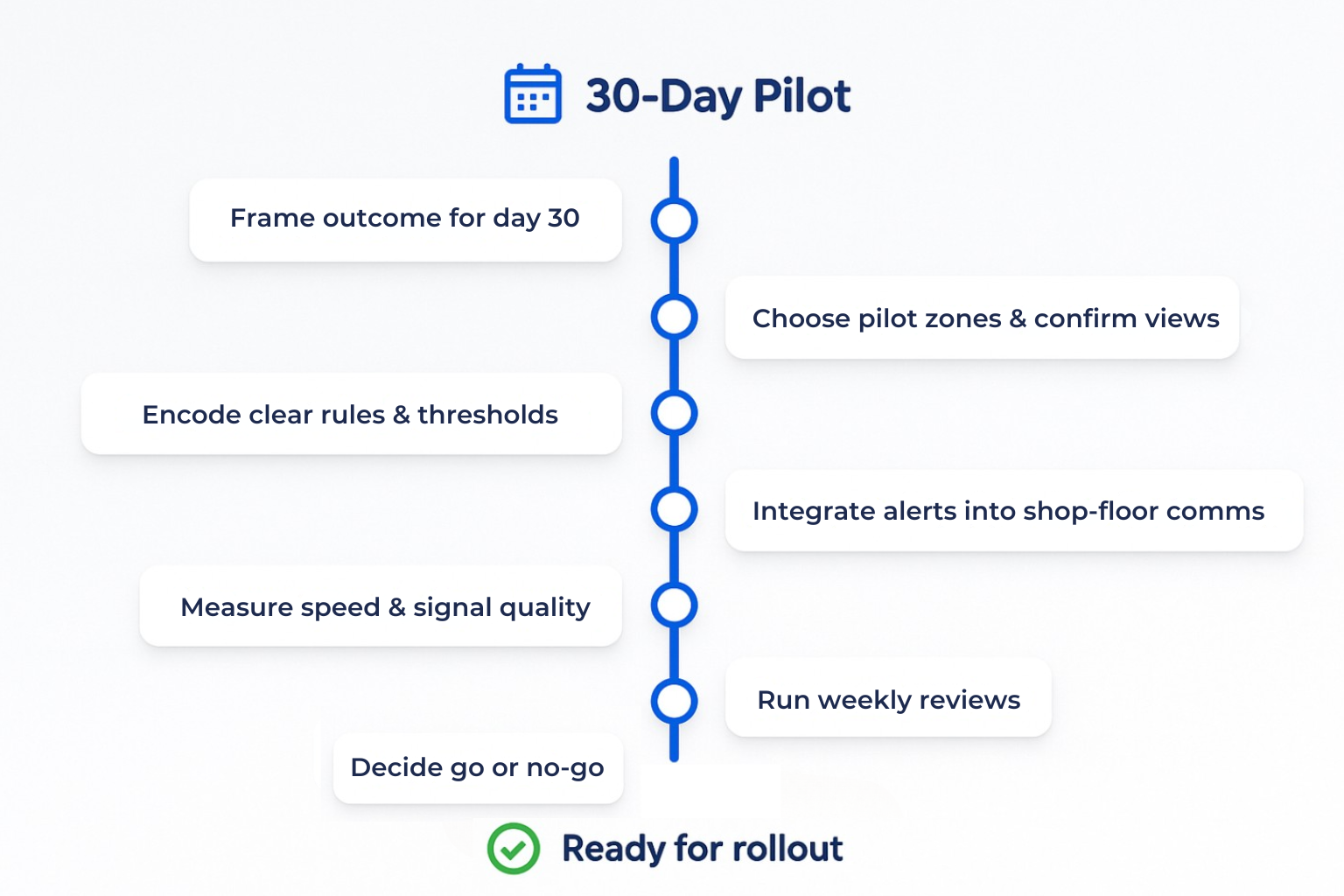
A short, structured pilot beats a long, vague trial. The aim is to prove that PPE misses become visible and corrected faster, with minimal noise and no throughput penalty. Use this step-by-step approach.
Step 1. Frame the outcome for day 30
Pick one to three measurable goals that supervisors recognise, for example, reducing helmet misses at line-side changeover or improving goggle adherence in the test bay. State the baseline you believe is true today, even if it is a rough estimate.
Step 2. Choose two to three pilot zones and confirm camera views
Select points where the rule applies and where people pause briefly, such as entrances to fabrication cells or paint booths. Open each view and confirm the head, torso, and hands are visible at the decision point. Ifthe views are poor, adjust angles and heights before you start.
Step 3. Encode clear rules and thresholds
Write one-line rules per zone. Avoid vague wording. If ear protection is required in stamping bays only during active presses, say so. Use simple thresholds where the system will alert, and set quiet hours to avoid out-of-shift notifications.
Step 4. Integrate alerts into shop-floor communications
Route alerts to the channels teams already use. Invigilo SafeKey publishes real-time notifications via WhatsApp, Microsoft Teams or SMS, which helps supervisors act without switching tools. Confirm the message content you want to see and who is in each recipient group.
Step 5. Measure speed and signal quality
Track time-to-intervention from alert to corrective action. Sample false positives by shift. Focus on clarity and consistency rather than chasing perfect scores. Tie each week’s settings back to what supervisors say they need.
Step 6. Run weekly reviews with simple artefacts
Share a one-page pilot log: zones, rules, alerts sent, actions taken, and any configuration changes. Keep a list of ambiguous cases to resolve together.
Step 7. Decide go or no-go at day 30
Roll forward only if the pilot shows faster interventions, acceptable noise and supervisor buy-in. If results are mixed, extend with a narrower scope or adjust camera views, then retest.
See the Invigilo SafeKey product overview to understand how existing camera integration and centralised event review are positioned for pilots and rollouts.
Which PPE Zone Rules Make AI Effective In Fabrication Cells, Paint Booths And Test Benches?
Good rules are specific, visible and tied to the work being done. In fabrication cells, head and eye protection is often applied at entry and while machines are energised. In paint or chemical booths, respirators and goggles may be required during application and clean-down. In electrical test benches, gloves and eye protection can be task-specific.
To encode this well, place rules at the point where decisions are made. Use signage that mirrors the wording in your analytics system. If occasional-use PPE applies, such as hearing protection during particular stamping cycles, write the condition plainly and test the view where people usually don gear. Run the pilot long enough to encounter shift changes and lighting variations, since clothing and glare influence model performance in ways supervisors notice. Invigilo’s manufacturing page confirms factory-relevant detections such as PPE violations, proximity to operating machinery and SOP breaches, which provides a workable starting point for most plants while you confirm your exact list in a demo.
Which Integrations Really Matter When Connecting PPE Events To Incident Logs And Audits?
Integrations matter when they reduce duplicate work. Start with alert routing to the tools supervisors already use. Invigilo SafeKey states that it integrates with existing site cameras, sends real-time notifications to WhatsApp, Microsoft Teams or SMS, and captures every event in a centralised dashboard, which covers the daily loop of detection, alert and review.
For audit and improvement, you will want a straightforward way to export events or review them centrally during toolbox talks. If your organisation maintains incident logs in an EHS or QHSE system, ask the vendor to show how events can be reviewed alongside other records. If the method is not published, request a demonstration and a short note in writing so your buyers know exactly what will happen after go-live.
The Invigilo Manufacturing page summarises factory use cases and is a useful internal reference for stakeholders who want a concise view before a demo.
How Should You Evaluate An AI Solution For Monitoring PPE Compliance In Manufacturing Plants During Vendor Selection?
Use a requirements list that reflects your real work. Keep it short enough for procurement and specific enough for engineers.
- Cameras and coverage
Confirm that the solution works with your existing camera network and that pilot views capture head, torso and hands at the decision point. Invigilo SafeKey explicitly positions existing-camera integration, which is a practical baseline to verify your views. - Detections that match your SOPs
Ensure PPE non-compliance categories and any manufacturing-specific unsafe actions you care about are supported. Invigilo’s manufacturing page lists PPE violations, proximity to operating machinery and SOP breaches as factory-relevant detections. Validate your exact list in the demo. - Alert routes supervisors will actually see
Require a live demonstration of alerts posting to WhatsApp, Microsoft Teams or SMS, since these channels are documented. Decide on routing and escalation groups with operations. - Event review and reporting
Ask to see the centralised event view and how events are searched or exported. If your audit team needs a specific format, confirm it during evaluation. - Pilot cadence and success criteria
Insist on a 30-day pilot with weekly reviews, a reasonable false-positive target, and time-to-intervention tracking. - Governance readiness
Discuss data retention, masking and access controls with your legal and HR partners. For reference, align with guidance used for PDPA in Singapore and GDPR in the EU, then confirm exact vendor settings in writing.
- People and change enablement
Clarify who owns rule maintenance and who closes the loop on alerts during busy shifts.
To validate these requirements on your own footage, book an Invigilo demo and test existing-camera integration, WhatsApp/Microsoft Teams/SMS alert routing, and your factory’s PPE rule set across two pilot zones.
What Common Mistakes Stall Adoption Of PPE AI In Manufacturing, And How Do You Avoid Them?
Unclear rules and views
The most common failure is vague rules combined with poor camera angles. Write rules as one-line statements that a supervisor recognises. Adjust views so decisions are visible.
Noise and fatigue
Unmanaged false positives exhaust goodwill. Start with conservative thresholds in the pilot. Sample alerts each week, then refine with supervisors.
No owner for the last mile
If no one is accountable for acting on alerts, the system becomes background noise. Assign a named owner for each zone and shift.
Skipping the communications piece
Alerts that land in an inbox no one checks will not change behaviour. Route to channels your teams already use. Invigilo SafeKey lists WhatsApp, Microsoft Teams and SMS as supported channels, which helps adoption if groups are defined clearly.
Treating AI like a one-off project
Models and workplaces change. A light, quarterly review of performance and rules keeps results steady as uniforms, lighting, and layouts evolve. This approach is consistent with how modern CV systems are evaluated in practice.
What Questions Do Buyers Ask Before Adopting PPE Monitoring AI In Factories?
1) Do I need to buy new cameras to use a PPE monitoring system in a factory?
Not necessarily. Invigilo SafeKey states integration with the site’s existing camera network, which is a common approach in this category. Validate your actual views during a demo so you know where adjustments are needed.
2) Can alerts reach supervisors where they already communicate?
Yes. Invigilo SafeKey publishes real-time notifications via WhatsApp, Microsoft Teams or SMS, which helps teams act without switching tools. Confirm routing groups, escalation rules and quiet hours during evaluation.
3) Which PPE types are supported out of the box?
Vendors describe support for PPE non-compliance in general terms. Invigilo’s manufacturing page highlights PPE violations for factories, along with proximity to operating machinery and SOP breaches. Confirm your exact list of PPE items and zone logic during the demo. Click here to book a demo!
4) How do we measure whether the system is accurate enough?
Use precision and recall per PPE category sampled on your footage, plus simple weekly reviews of alerts and non-alerts. Recent reviews and practical guidance in the literature describe these measures and deployment barriers, which helps you design a realistic evaluation. (Ministry of Manpower Singapore)
5) What is a reasonable implementation timeline?
A focused 30-day pilot is sufficient to prove value for a small set of zones if camera views are already good and rules are clear. The rollout that follows depends on the number of lines and the level of change management you need.
What Is The Practical Next Step For Adopting An AI Solution For Monitoring PPE Compliance In Manufacturing Plants?
Adopting an AI solution for monitoring PPE compliance in manufacturing plants is most effective when you turn it into a short, evidence-based programme rather than a long pilot with vague goals. Keep the pattern simple and repeatable. Use your existing cameras, encode clear zone rules where decisions are made, route alerts to WhatsApp, Microsoft Teams or SMS so supervisors actually see them, and review events centrally so improvements stick. Start with a focused 30-day pilot that measures time to intervention and a manageable false-positive rate, and validate detections on your own footage rather than relying on benchmarks. Align retention and access controls with your governance before go-live, and write down exactly who owns rules, reviews and responses on each shift.
Your next steps are straightforward. Draft a short requirements list tied to your SOPs, name two pilot zones and confirm the views where rules apply, and involve the supervisors who will act on alerts. Agree on routing groups, escalation rules and quiet hours in advance, then schedule weekly reviews that adjust thresholds without slowing production. Set a clear go or no-go at day 30 and, if successful, roll out in stages with a light quarterly check to keep accuracy and rules current. If you want to see this on your floor, book a demo with Invigilo, request the sample pilot worksheet, and bring snapshots of your camera views so detections and alert routes can be tested on your channels during the session.
Ready to move from audits to observable PPE compliance on the line. Book your Invigilo demo and bring two pilot zones to test on your footage so your team can make a confident go or no-go decision.
Related posts

Underground Changes Every Safety Rule You Know
Singapore's Cross Island Line runs 70m below ground. Underground construction inverts work at height, plant proximity and lone worker risk. Here is how.

Why Australian Industrial Sites Stopped Buying CCTV AI
Australian HSE leaders aren't buying video analytics anymore. They're buying safety intelligence. Here's what the shift means for WHS in 2026.

What to Demand from AI Video Analytics on an Oil and Gas Site in Saudi Arabia
AI safety platforms built for general workplaces are being sold into Saudi oil and gas operations. Here are the 8 questions that reveal the difference.